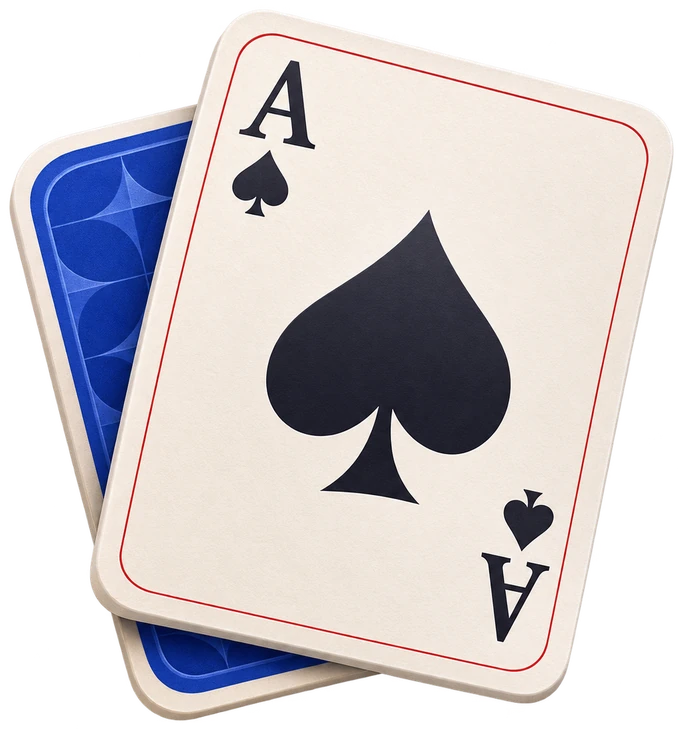
Solitaire is a family of card games.
Solitaire is the name for many card games you can play by yourself. The usual challenge is to arrange, move or remove cards according to a set of rules. Some games ask you to build piles from Ace to King. Others challenge you to clear every card from the table.[4][1]
In North America, solitaire often brings to mind Klondike: the familiar game with seven columns and a stock pile. But Klondike is only one member of a much larger family. Spider, FreeCell and Golf are all solitaire games, even though they play quite differently.
How do solitaire card games work?
Most begin with a shuffled deck laid out in a particular pattern. From there, you make moves that follow the rules of the game. Some cards are visible immediately; others may be turned over as you play.
It helps to know a few everyday terms:
- Tableau: the cards laid out on the table where you make most of your moves.
- Foundation: a pile you build toward completing the game, often from Ace to King in a single suit.
- Stock: cards waiting to be drawn, when the game has a draw pile.
- Reserve: a place to hold cards temporarily in some games.
Not every game uses all four parts. FreeCell, for example, shows every card from the start and has no stock. Golf revolves around clearing cards onto one discard pile.
Why is solitaire also called patience?
Patience is the traditional name still widely used in Britain and other parts of the world. Solitaire is more common in American English. Card-game historian David Parlett explains that these names developed over time and that related words appear in several European languages.[2]
A 1911 edition of Encyclopaedia Britannica described patience as a group of one-person card games, distinguishing games largely directed by luck from those offering more opportunities for judgment. It is a useful historical description, although modern games and terminology are more varied.[3]
History & origins
No single inventor or precise birthplace of solitaire is securely documented. Written accounts of patience-like card games appeared in Europe during the late eighteenth century. In the nineteenth century, published collections helped spread different versions and their names.[1][2]
Some stories connect solitaire to famous historical figures, including Napoleon, but an entertaining story is not the same thing as proof that someone invented or regularly played a particular game. Early books and dated descriptions tell us more reliably how the rules and names evolved.
Many variants are hard to date because people played them at home long before anyone wrote down the rules. That is also why two versions with the same name may not work in quite the same way.
How solitaire became a computer classic
Solitaire found a new audience when personal computers became common. Microsoft included its version of Klondike in Windows 3.0 in 1990. The Strong National Museum of Play documents the people behind that software and its role in making the game familiar to a generation of computer users.[5]
Computer versions made it easy to shuffle, deal and try again. They also introduced many people to other games, including FreeCell and Spider. None of those programs invented the wider tradition of playing patience with physical cards.
Which solitaire game should you try first?
Start with Klondike if you like drawing cards and gradually uncovering hidden ones. Try FreeCell if you prefer to see every card and plan ahead. Golf makes a good short game, while Spider gives you a larger, more demanding puzzle with two decks.
Every game has its own rules, so pick one that sounds interesting and learn the setup before worrying about the best strategy.
Sources & further reading
- 01Mark Dziak (2023). Solitaire — Research Starters: Sports and Leisure.
EBSCO Research · Encyclopedia / research reference
View source ↗ - 02David Parlett (undated). History of Patience/Solitaire.
David Parlett — original games historian essay · Specialist historical essay
View source ↗ - 03Encyclopaedia Britannica contributors (1911). Patience (11th edition).
Encyclopaedia Britannica, historical edition; transcription hosted by Wikisource · Historical encyclopedia
View source ↗ - 04Oxford University Press (dictionary entry) (2018 (online listing)). Solitaire — The Oxford Pocket Dictionary of Current English.
The Oxford Pocket Dictionary of Current English, reproduced by Encyclopedia.com · Reference dictionary
View source ↗ - 05The Strong National Museum of Play (2021). Microsoft Solitaire — World Video Game Hall of Fame.
The Strong National Museum of Play · Museum / institutional history
View source ↗