
What is Klondike Solitaire?
Klondike is the classic game most people mean when they say “solitaire.” You arrange cards in seven columns, uncover hidden cards and try to build four piles from Ace to King.[4]
How to set up the cards
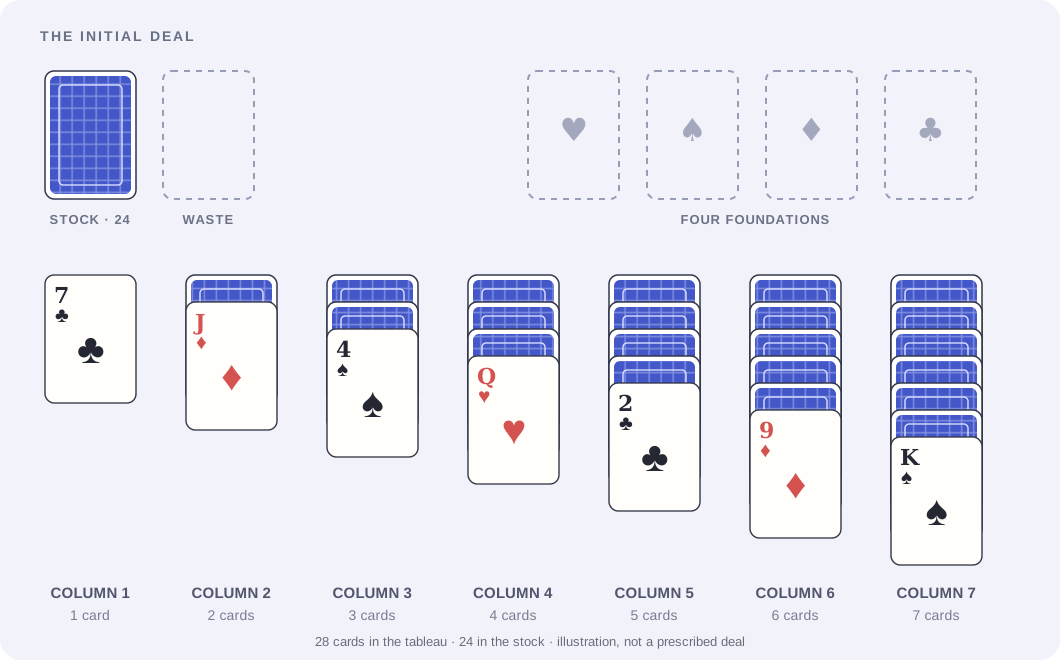
Start with the following arrangement.[4]
- Shuffle a standard 52-card deck without jokers.
- Make seven columns with 1, 2, 3, 4, 5, 6 and 7 cards. In each column, turn only the top card face up.
- Place the remaining 24 cards face down as the stock. Leave room for a waste pile and four foundation piles.
How to play
Follow these rules for the version described here.[4]
- On the seven columns, place cards in descending order and alternate red and black. For example, put a red 9 on a black 10.
- You may move a correctly ordered group of face-up cards together.
- Only a King, or a group beginning with a King, may go into an empty column.
- When you uncover a face-down card at the end of a column, turn it face up.
- Move Aces to the four foundation piles, then add the 2, 3 and so on up to King in the same suit.
- Turn over three cards from the stock at a time, placing them on the waste pile. Only the top waste card is available to play. In this version, you may go through the stock again without a set limit.
An example of a move
Imagine a red 8 at the bottom of a column, with a face-down card beneath it. Another column ends with a black 9. Move the red 8 onto the black 9.
You can now turn over the hidden card that was beneath the 8. Revealing a card gives you another option, even if you have not moved anything to a foundation yet.
If you empty a column, remember that only a King (or a group starting with a King) can fill it. Check whether you have one available.
Tips for playing
These tips can help you decide what to do next. They are suggestions, not guaranteed ways to win.
- Try to uncover face-down cards whenever you have a choice between equally useful moves.
- Before clearing a column, see whether you have a King ready to move into the space.
- Do not rush every available card to a foundation. Sometimes it is useful to keep a card in play a little longer.
Common mistakes
- Placing two cards together does not always mean you can separate them however you like: move only groups that follow the building rules.
- Not every version lets you move a card back from a foundation. Check the rules you are using.
- Turning one stock card at a time and turning three can feel like very different games.
Popular variations
You can draw one card or three at a time from the stock. Some rules limit how often you can turn over the stock, while others allow unlimited passes. This guide uses draw-three with unlimited redeals.[4]
History & origins
Klondike is one of the best-known forms of patience. David Parlett traces the wider pastime through European sources and notes that the game took its name from the Klondike Gold Rush. That name does not by itself establish who invented the layout.[3]
A book published in 1914, Lady Cadogan’s Illustrated Games of Solitaire or Patience, includes the heading “Canfield or Klondike.” The name was applied to a game with rules different from what many people now call Canfield.[2]
Microsoft included a digital version of Klondike with Windows 3.0 in 1990. The Strong National Museum of Play credits Wes Cherry with the original Windows program and Susan Kare with the playing-card artwork.[1]
Frequently asked questions
How many cards start face down?
There are 21 face-down cards spread across the seven columns.
Can a Queen go into an empty column?
No. Only a King, or a group beginning with a King, may fill an empty column.
Can every game be won?
No. Some deals cannot be completed, and the exact rules affect what is possible.
Sources & further reading
- 01The Strong National Museum of Play (2021). Microsoft Solitaire — World Video Game Hall of Fame.
The Strong National Museum of Play · Museum / institutional history
View source ↗ - 02Lady Adelaide Cadogan, revised edition (1914). Lady Cadogan’s Illustrated Games of Solitaire or Patience — “Canfield or Klondike”.
David McKay Company; public-domain digitization by Project Gutenberg · Historical primary book / digital archive
View source ↗ - 03David Parlett (undated). History of Patience/Solitaire.
David Parlett — original games historian essay · Specialist historical essay
View source ↗ - 04Jonathan Blandford / GNOME AisleRiot project (undated). Klondike — game rules.
GNOME AisleRiot open-source manual · Original software rules manual
View source ↗